
Global Cooling Watch 2025: The Free Degrees
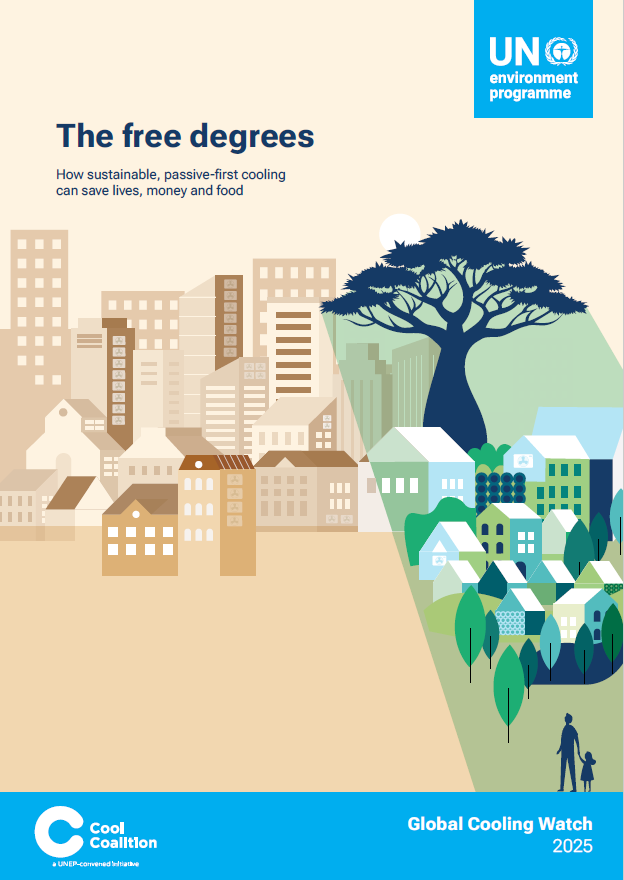 In November 2025 the United Nations Environment Programme released the report Global Cooling Watch 2025: The Free Degrees. The document outlines pathways to achieve sustainable and equitable access to cooling as extreme heat events become more frequent and intense worldwide.
The report warns that societies cannot “air-condition their way out” of the heat crisis. Without action, global cooling demand could more than triple by 2050, driving emissions to unsustainable levels and placing severe strain on electricity grids. At the same time, more than one billion people already lack adequate access to cooling, with the greatest risks faced by low-income and vulnerable communities.
A central message of Global Cooling Watch 2025 is the critical role of passive cooling as the first and most equitable response to extreme heat. Measures such as climate-responsive building design, shading, insulation, natural ventilation, cool surfaces and urban green spaces can reduce indoor temperatures by several degrees while cutting energy demand at the source. These approaches are complemented by low-energy solutions such as fans, which can significantly improve thermal comfort and reduce reliance on air conditioning. These “free degrees” lower cooling needs, reduce emissions and improve comfort without increasing electricity costs.
By prioritising passive and low-energy solutions, the report shows that up to 65 per cent of emissions reductions in the Sustainable Cooling Pathway can be achieved, while expanding access to cooling for billions of people. Scaling passive cooling through building codes and urban planning is therefore not only a climate imperative, but a matter of equity and resilience in a warming world
To download and read the full report please click here.
Source: United Nations Environment Programme (2025). Global Cooling Watch 2025: The Free Degrees. https://www.unep.org/resources/global-cooling-watch-2025