
Workshop on Unlocking energy efficient Ventilative cooling in emerging CEN & ISO standards
On September 24-26, 2025 we had the privilege of attending the 45th AIVC (Air Infiltration and Ventilation Centre) – ASHRAE IEQ joint – 11th Venticool conference titled “IEQ 2025: Rising to new challenges: Connecting IEQ to a sustainable future” held in Montreal, Canada. The event covered 3 days filled with valuable insights and good company.
Ventilative cooling is a sustainable and energy-efficient method of cooling buildings, utilizing natural, mechanical or hybrid means to remove excess heat. This process harnesses the cooling potential of outdoor air to reduce indoor temperatures, thereby decreasing the reliance on active cooling systems like air conditioning. With the rise in outside temperatures – for future buildings to be resilient and mitigate overheating properly, it must be ensured that guidelines, standards and legislation support this – in order to guide designers correctly.
We therefore organized and chaired a 90-minute topical session called; “Unlocking energy efficient ventilative cooling through emerging CEN & ISO standards” which attracted a good crowd allowing for lively discussions. We extend our gratitude to presenters Paul D O’Sullivan (Munster Technological University, Ireland) and Benjamin Jones (University of Nottingham, UK) for sharing their views on the latest developments in international standards on ventilative cooling evolutions through well-researched design methods, seen from a UK, Irish and international perspective.
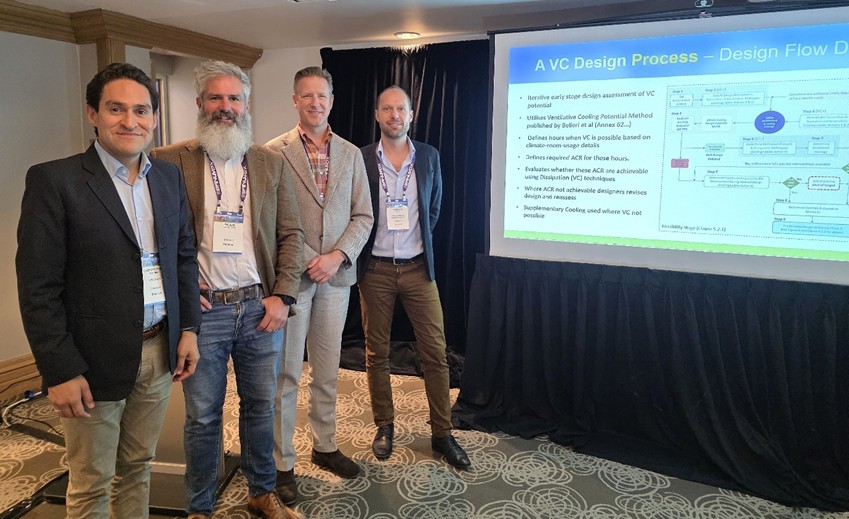
Photo: From left to right: Christoffer Plesner, Paul D. O’Sullivan, Benjamin Jones and Jannick Roth
During the topical session we, among other things presented the latest content of the upcoming European Technical Specification (prCEN/TS) called “Ventilative cooling systems – Design” to mitigate overheating, discussed robust thermal Resilience design evaluations for an Irish case study where Low Energy Schools in Ireland designed with Ventilative Cooling principles are proving resilient to future climate warming. Further we discussed how ventilative cooling is implemented in the updated version of CIBSE AM 10 in UK.
Inclusion of ventilative cooling in CIBSE AM 10 in UK
Participants were given valuable insight into the recently amended CIBSE AM10, “Natural Ventilation in Non-Domestic Buildings”, which provides expanded guidance on the design and application of natural ventilation systems. CIBSE AM10 serves as a best-practice guidance document for engineers, architects, and designers aiming to create buildings that enhance occupant comfort, improve energy efficiency, and reduce environmental impact through the effective use of natural ventilation. The revised document addresses a broad range of topics, including the fundamental principles of natural ventilation, system typologies, design strategies, performance evaluation methods, and the integration of natural ventilation with other building services. Its relevance extends beyond the UK, as the document is referenced in international frameworks such as ASHRAE 62.1 and increasingly influences certification schemes including LEED.
Benjamin Jones, provided an in-depth overview of the most significant updates to CIBSE AM10, where the introduction of ventilative cooling was given, as a clearly defined concept within the guidance. The document now enables ventilative cooling performance to be assessed using established fundamental evaluation methods, strengthening its role as a practical design reference.
This interaction with other standards was emphasized as a key strength, as a central reference for modern natural ventilation design, supporting the transition towards more energy-efficient, comfortable, and climate-resilient buildings worldwide. This reinforces its growing influence on an international scale and its role in aligning natural ventilation and ventilative cooling strategies across regulatory and voluntary frameworks.
Upcoming European specification on Ventilative cooling systems – Design
The “Ventilative cooling systems – Design” (prCEN/TS) provides a framework for designing buildings without mechanical cooling (hence, free cooling systems) from the early Feasibility phase to the Detailed design phase for both residential and non-residential buildings, where focus is on the early design stage; currently the only available Technical Specification in Europe explaining how to design (free) cooling systems.
This document focuses on the performance-based approach framework for designing ventilative cooling systems, including several elements, such as different ventilation requirements and conditions of use, among others, that can be selected on national basis and shown in the corresponding flow diagram in Figure 1. There is also included guidance to additional design interventions on room and building level, e.g. add wall switches, solar shading or thermal mass, to continuously increase the relevance of ventilative cooling usage. With a better early-stage design prediction method, such as the ventilative cooling potential method, a reference to our document in prEN 16798-1-2 (thermal comfort revision) would increase the likelihood of more resilient cooling solutions, that could intermittently replace mechanical cooling solutions, when the outdoor conditions allow – both saving cooling energy and reducing CO2 emissions through lower material usage than mechanical cooling systems.
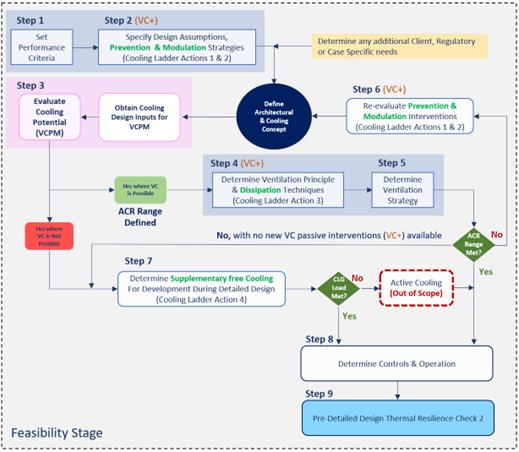
Figure 1 – Flow diagram of ventilative cooling system design (source: Ventilative cooling systems – design (prCEN/TS), 2026)
Core Features of the Document:
- 9 design steps– practical guidance for designing Free cooling systems (e.g. with openable windows)
- Cooling ladder ethos– that guides how to first design passively before moving to active cooling means. See Figure 2
- Ventilative cooling potential method– assessing outdoor air cooling potential in the early design phase
- Resiliencechecks – enabling checks to enhance readiness for future extreme weather events (probably the first standard to include this)
- Renewable energy for cooling method– addressing elevated airflow rates beyond the standard – as found in Renewable Energy Directive (RED II/III)
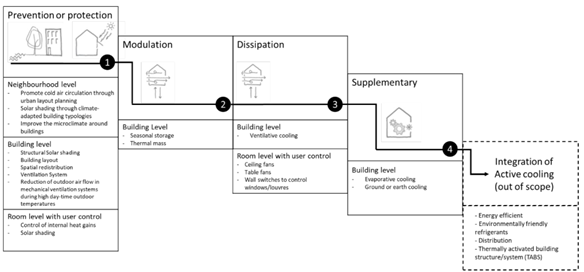
Figure 2 – Cooling ladder ethos from passive to active means
Discussions and conclusion
During the discussion part of the session, we received insightful inputs to draw important conclusions such as:
- It all starts with IEQ requirements and perhaps we are currently setting too strict requirements. e.g. the temperature bands are too narrow, which might not be beneficial in some cases and we might end up oversizing the cooling systems.
- The importance of including thermal mass, for most “correct” performance estimation.
- The importance in handling resiliency (e.g. power outages) in the design to secure robust systems.
- The significance of including the micro-climate around the building at different design stages.
- Climate data is key to assessing ventilative cooling properly and given that the ventilative cooling potential method can handle different climate data is valuable.
We greatly appreciate the constructive feedback at our session at AIVC 2025 and it was a great pleasure to meet familiar faces and discuss important aspects of how to achieve good well-being in buildings using ventilative cooling, and how standards and legislation can help to support this.
Christoffer Plesner – VELUX A/S and Jannick Roth – WindowMaster International A/S